
Lady Lent is one of the most important traditions of the Lenten period and is closely connected with popular religious life and the family customs of earlier times.
In Amfikleia, as in many regions of Central Greece, the women of the household would shape her figure from simple dough—flour and water—the same ingredients used for making everyday bread. In this way, the dough itself became a bearer of faith and symbolism.
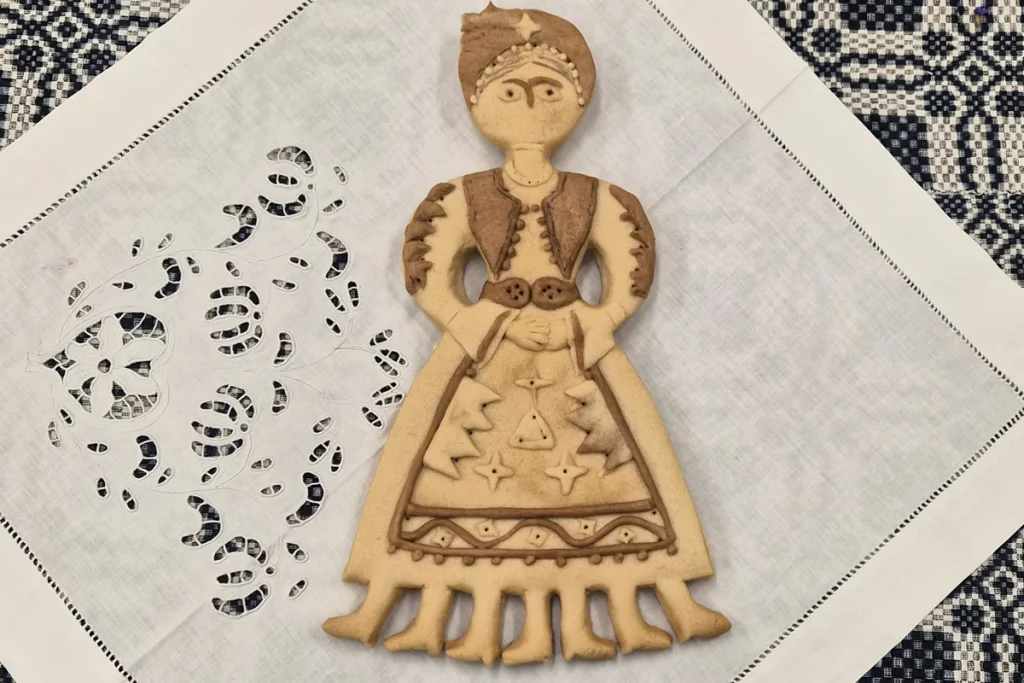
Her form was simple, yet deeply symbolic:
The cross on her head represents faith and the sacred period of Lent.
Her crossed arms express a posture of prayer and contemplation.
The absence of a mouth symbolizes fasting and restraint.
The absence of a nose, in some traditions, represents the avoidance of “desire.”
Her seven legs correspond to the seven weeks from Clean Monday to Holy Saturday.
Each Saturday, one leg was cut off, marking the passage of time toward Holy Week. In this way, Lady Lent functioned as a simple yet meaningful folk calendar, in a time when people measured time through religious feasts and the ringing of church bells.
In the homes of Amfikleia, her presence was not only religious but also educational. Children learned the values of fasting, patience, and anticipation of Easter. Shaping her figure was part of the weekly bread-making ritual—an act deeply rooted in tradition and imbued with a sense of reverence.
The preservation of this custom to this day reminds us that bread was not merely a staple of nourishment, but also a medium of cultural expression. At the Bread Museum of Amfikleia, Lady Lent stands as a living testimony to the connection between dough, faith, and the collective memory of the community.
” As older women of Amfikleia recall, ‘we shaped her together with the Saturday bread, and each week the children would wait to see who would cut off the little leg.’ It was a simple yet meaningful way to count the days until Easter and to take part in the spirit of fasting.”
«The Song of Kyra Sarakosti»
Lady Lent, an old tradition,
from the days of long ago,
our grandmothers would shape her
out of flour and water dough.
On her head, a cross they placed,
as a blessing and a sign,
and her mouth was closed in silence,
for fasting and for prayer divine.
They would count the passing weeks
by her seven little feet,
cutting one off every Saturday
till the Easter feast would greet.