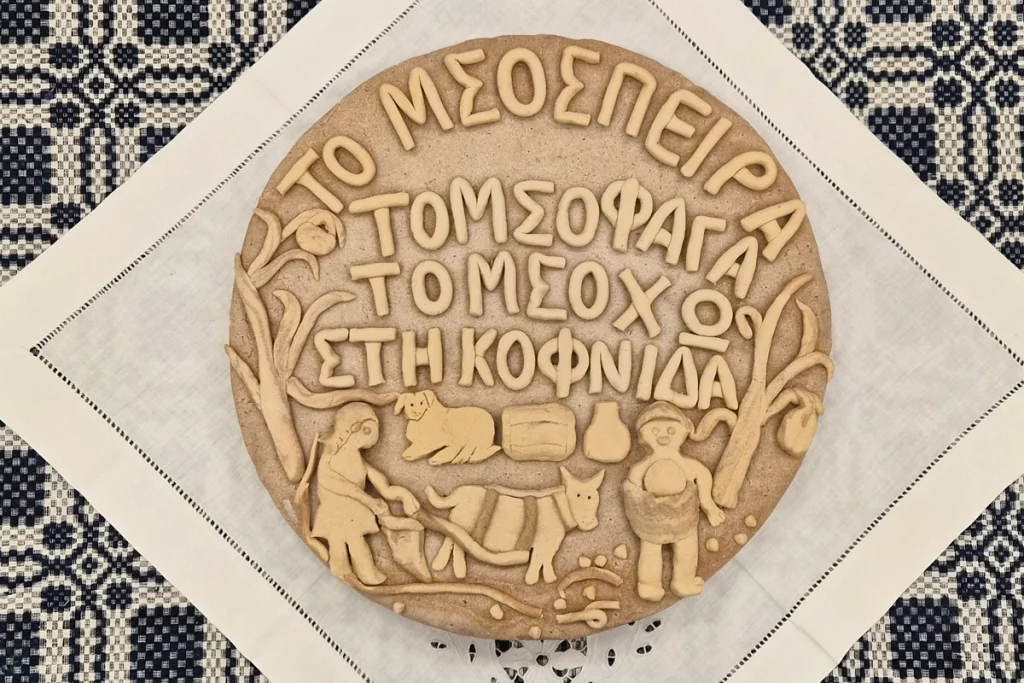
Carved onto a simple pie, this phrase holds within it an entire philosophy of life.
In agrarian society, nothing was taken for granted. The seed had to be saved for the next harvest. Bread had to be shared fairly at the table. And something always had to remain in the kofnida—the household basket—for the following day.
The phrase “Half I sowed, half I ate, half I kept in the basket,” inscribed on a pie, is not merely a clever saying. It is the distilled wisdom of a society that learned to live with measure.
Half I sowed — the seed is not consumed entirely; it is preserved so it can return to the earth.
Half I ate — life continues; the body needs nourishment, the household needs bread.
Half I kept in the basket — provision for tomorrow; the household basket must not be left empty.
In truth, “half” is not a mathematical calculation. It is a way of life. It is the balance between the present and the future.
The Cyclical Nature of Life in Amfikleia
In agrarian Amfikleia, nothing ended with consumption. Bread was not the end of wheat; it was a link in a continuous cycle:
seed – grain – threshing – milling – kneading – bread – and once again, seed.
This cycle extended beyond the land to the life of the community itself. What the earth provided returned to it. What the family held, it shared. What remained became hope for the year to come.
The carved pie, therefore, speaks not only of food, but of continuity, self-sufficiency, and respect for labor and the land.
Through this simple phrase, Amfikleia remembers the way it learned to endure:
with measure, with wisdom, and with faith in the cycle of life.